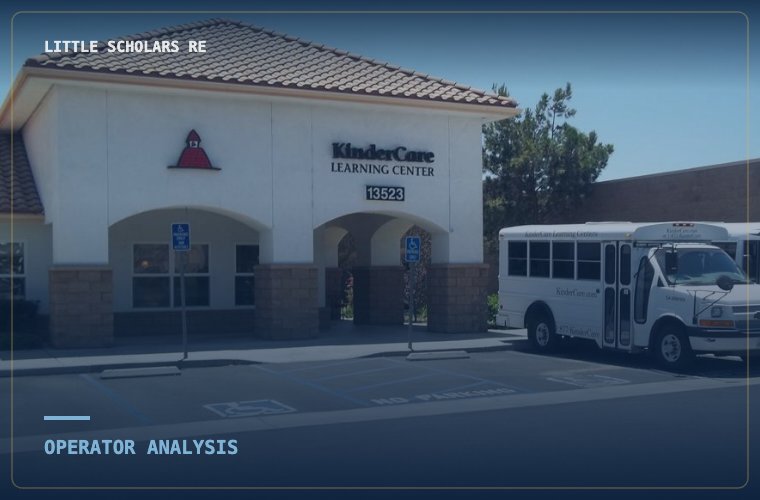
On September 2, Goldman Sachs lent $650 million against a 549-property KinderCare portfolio — three weeks after KinderCare's stock lost roughly half its value. The gap between those two facts is the most useful thing in the childcare market right now.
What happened
On September 2, 2026, an entity tied to NRT — a private REIT backed by the Milken brothers, formerly known as National Realty Trust — closed a $650 million loan from Goldman Sachs, according to Massachusetts mortgage records reported by Bisnow. The loan refinances a 2021 CMBS facility secured by 549 daycare properties totaling more than four million square feet across 37 states.
It pays off the $642 million floating-rate loan NRT took out in July 2021, which carried a two-year term plus three one-year extension options. That loan matured last month and, according to Morningstar Credit remittance data, was paid in full.
Why the timing matters
Three weeks earlier, KinderCare's stock fell roughly 50% in mid-August, from $4.83 to $2.60, after second-quarter results showed continued enrollment decline. The operating company lost half its market value; the real estate under its centers refinanced at scale a few weeks later.
That is the clearest available demonstration of something we tell owners constantly: the building and the business are two different assets, priced by two different sets of buyers, on two different sets of numbers. A soft quarter at the operating company does not automatically reprice the dirt.
The number that made the loan work
As of March 2026, the portfolio produced more than $85 million of net operating income against $42 million of annual debt service — coverage of roughly 2.0 times. That is the same test a lender or buyer runs on a single center, just with three more zeros.
If you own one building, the equivalent question is what share of your gross revenue goes to rent. Under 12% is comfortable. Between 12% and 15% invites scrutiny of your enrollment trend. Above 15%, most buyers re-cut the offer or ask for a lease restructure as a condition of closing. Coverage is what gets deals financed, at every scale.
Master leases are being renegotiated, not abandoned
In August, KinderCare and NRT executed a fifth amendment to their master lease, restructuring occupancy terms across more than 500 sites and transferring 13 sites to a newly formed entity. The portfolio itself dates to 2015, when KinderCare entered a sale-leaseback with NRT as part of the $1.3 billion sale of its parent company to Partners Group; the Milken brothers retained a large share of the real estate.
For landlords leasing to any national operator, that is the pattern to watch. As KinderCare works through its 80-to-85-center closure program this year, expect more restructures, more lease exits, and more buildings changing hands — but negotiated, not defaulted.
What this means if you own a center
First, do not read the operator's stock chart as a read on your property. Lenders just underwrote 549 of these buildings on rent coverage and lease structure, not on quarterly enrollment.
Second, capital is still arriving. The U.S. childcare market was valued at $65.2 billion in 2025 and is projected to reach $109.9 billion by 2033, and private equity continues to convert underused retail space into licensed centers.
Third, the split is widening between product types. Across our own tracked comp set, rent on centers built within three years of their sale rose from $30.02 per square foot in 2023 to $39.57 in 2026 — an all-time high — while second-generation space fell from $29.60 to $21.44 over the same period. New, purpose-built, well-covered real estate is being financed and bought. Older, weakly enrolled space is not.
All figures above come from Bisnow's September 4, 2026 report, which cites Massachusetts mortgage records, Morningstar Credit CMBS data, and KinderCare's SEC filings; verify against primary sources before relying on any number in a transaction.
Find out what your school is worth.
A confidential, no-pressure valuation from a broker who has owned, operated, and sold childcare centers for nearly 40 years.

Alan Stahl
Founder & CEO of Little Scholars Real Estate. Alan has owned, operated, and brokered childcare centers for nearly 40 years, with 80 transactions closed across 18+ states. Meet Alan and the team →