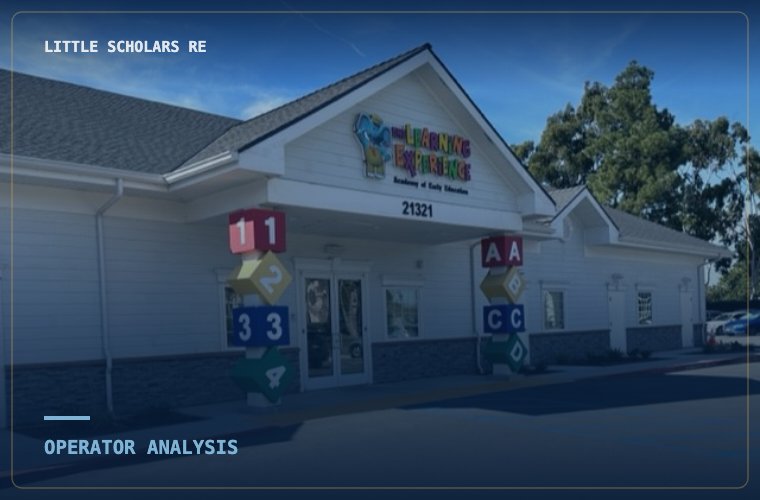
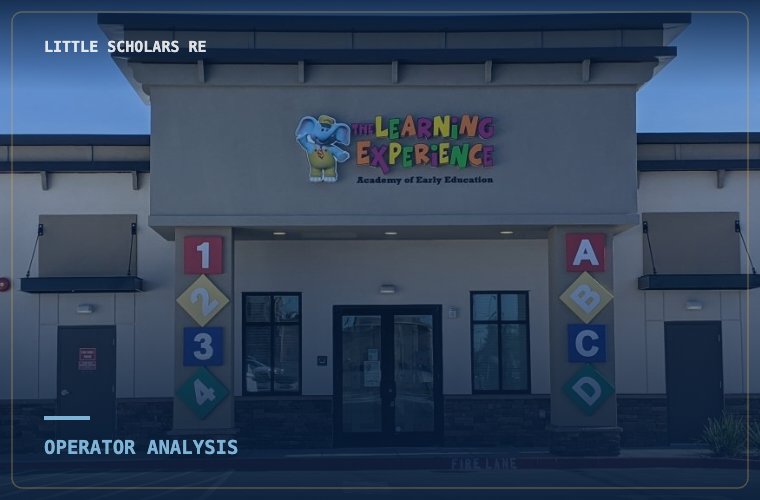
Bright Horizons (NYSE: BFAM) built a ~$2.9 billion business on employer-sponsored care. Its 2025 results show why that model produces unusually durable demand — and unusually resilient real estate.
A different revenue engine
Public since 2013, Bright Horizons generated about $2.93 billion in revenue in fiscal 2025, split roughly 71% full-service center-based child care, 25% back-up care, and 4% educational advisory services. That mix is the whole story.
Unlike operators dependent entirely on parent tuition, Bright Horizons anchors much of its demand in employers. As of year-end 2025 it served more than 1,450 employer clients — including over 220 Fortune 500 companies — operating about 1,010 centers with capacity for roughly 115,000 children across the U.S., U.K., Netherlands, Australia, and India.
The 2025 trajectory, in management's own words
Momentum built through the year. Q1 2025 revenue rose 7% with net income up 124%; Q2 climbed 9% to $731.6 million; and Q3 rose 12% to $802.8 million, with income from operations up 35% and net income up 43%.
The Management's Discussion & Analysis attributed the gains to rising utilization of back-up care plus enrollment growth and margin improvement in center-based care. On the Q2 earnings call, CEO Stephen Kramer called client relationships a core strength of the model, with rising employee usage underpinning growth — a sign that the employer-funded model was firing on multiple cylinders even as parts of the industry softened.
Why the real estate holds up
Employer-funded demand is far less sensitive to economic swings than discretionary household spending. A center anchored by employer contracts, or sited near major employment hubs, enjoys steadier occupancy through cycles. Bright Horizons' own MD&A repeatedly frames capacity, not demand, as the constraint, which is the healthier problem for a landlord to underwrite.
For a landlord, a lease backed by that kind of contracted, diversified demand is a defensive asset — closer in spirit to essential-services real estate than to discretionary retail.
The constraint is labor, not demand
Bright Horizons' own disclosures flag labor availability as a leading risk — the recurring theme across the sector. When the binding constraint is staffing rather than demand, that's the healthier problem for a real estate owner to underwrite: the families want the slots; the challenge is fielding the teachers to serve them.
Operators with scale, brand, and wage competitiveness manage that constraint better, which is part of why institutional capital favors them.
What it means for owners
Centers tied to employer demand, or located near dense employment, carry a resilience premium worth surfacing to the right buyers. The same building can command a tighter cap rate when its income is framed as recession-resistant, essential-services real estate.
We help owners of these assets reach the investors who specifically prize that durability — and price it accordingly.
Find out what your school is worth.
A confidential, no-pressure valuation from a broker who has owned, operated, and sold childcare centers for nearly 40 years.

Alan Stahl
Founder & CEO of Little Scholars Real Estate. Alan has owned, operated, and brokered childcare centers for nearly 40 years, with 80 transactions closed across 18+ states. Meet Alan and the team →